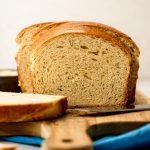
Anise Bread Recipe
A lightly sweetened yeast bread with a tender crumb, flavored with anise extract and dotted with anise seeds-- this is a recipe that has been in my family for generations.
Servings: 12 servings
Ingredients
- ¼ cup (60mL) warm water
- ⅓ cup (67g) granuated sugar
- 2 and ¼ teaspoons (7g) dry active yeast or 1 packet
- ½ cup (120mL) warm milk I prefer whole milk
- ¾ teaspoon salt
- ½ cup (113g) unsalted butter melted
- 1 heaping teaspoon anise seed
- 2 teaspoons anise extract
- 2 large eggs room temperature
- 3 and ½ to 4 cups (420-480g) bread flour1 be sure to measure properly
- egg wash: 1 large egg + 1 Tablespoon of water
Video
Want to remove ads from this site?Check out my Fresh Dough Club!
Instructions
- Add the warm water water to the bowl of a stand mixer or a large bowl (if you are going to use a wooden spoon or silicone spatula). Add the granulated sugar and yeast, then whisk or stir the mixture and let it rest for 5-10 minutes to allow the yeast to activate.¼ cup (60mL) warm water, 2 and ¼ teaspoons (7g) dry active yeast, ⅓ cup (67g) granuated sugar
- When the yeast is bubbly, add the milk, salt, anise seed, anise extract, melted butter, and eggs. Whisk or stir to combine.½ cup (120mL) warm milk, ¾ teaspoon salt, ½ cup (113g) unsalted butter, 1 heaping teaspoon anise seed, 2 teaspoons anise extract, 2 large eggs
- Gradually stir in the flour. If you are using a stand mixer, use your dough hook. If mixing by hand, continue to use a wooden spoon or spatula. Add flour until your dough is soft enough to handle, usually when it can easily pull away from the sides of your bowl.3 and ½ to 4 cups (420-480g) bread flour1
- Allow the dough to continue mixing, or kneading, for 8-10 minutes. You can also do this by hand on a lightly floured surface. If you are kneading by hand and the dough is too sticky, add only 1 teaspoon of dough at a time and keep kneading. The dough is finished kneading and ready to rise when it is slightly tacky and soft (it will remind you of fresh PlayDoh)
- Spray your bowl with non-stick spray or oil and place the dough ball into the bottom of the bowl. Flip the dough ball over to coat the top, and then cover the bowl with a lid or towel and place in a warm environment. I like to heat my oven to 200ºF (93ºC), turn it off, then leave the door cracked with the bowl inside. Allow dough to rise until double in size, about 2 hours.
- When the dough has risen, spray a 9" x 5" loaf pan with nonstick spray and set aside. Turn the dough out onto a lightly floured surface. Gently pat and press2 the dough into a 9" x 12" rectangle. You may also use a rolling pin, but be gentle.
- Starting at the short end, roll the rectangle up into a tight log. Pinch the ends to seal and tuck the ends of the roll under the bread. Place into prepared loaf pan, and cover again loosely with a kitchen towel and allow to rise until doubled in size, about 45 minutes to 1 hour.
- When you are ready to bake the bread, set the rack to the middle position in your oven and preheat it to 350ºF (177ºC).
- Using a pastry brush, brush the loaf with the egg wash. Bake the loaf for 36-40 minutes. Loaf is done when the top is golden brown and tapping on the top of bottom of the loaf produces a hollow sound. Loaf stays fresh covered at room temperature up to 1 week. Loaf may be frozen, wrapped tightly, up to 3 months. Thaw to room temperature before serving.egg wash: 1 large egg + 1 Tablespoon of water
Notes
- Bread flour: this is not absolutely imperative to this bread. I've used bread flour and all-purpose flour interchangeably, and I enjoy both textures. Bread flour will make your bread slightly softer, but all-purpose will work perfectly fine if you don't have bread flour on hand.
- Shaping the dough: for a more rustic look, you can simply shape the dough without rolling it up into a neat log. You can see in the post that I have pictures of both finished loaves.
- Working with yeast: for a comprehensive look at working with yeast in a recipe, see my post about how to bake with yeast.
Nutrition Disclosure
All nutritional values are approximate and provided to the reader as a courtesy. Changing ingredients and/or quantities will alter the estimated nutritional calculations.
Serving: 1serving | Calories: 146kcal | Carbohydrates: 14g | Protein: 3g | Fat: 9g | Saturated Fat: 5g | Polyunsaturated Fat: 1g | Monounsaturated Fat: 2g | Trans Fat: 0.3g | Cholesterol: 49mg | Sodium: 161mg | Potassium: 45mg | Fiber: 0.4g | Sugar: 6g | Vitamin A: 293IU | Vitamin C: 0.02mg | Calcium: 21mg | Iron: 0.3mg
