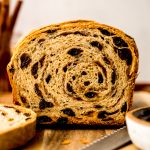
Homemade Cinnamon Raisin Bread Recipe
Learn how to make soft, perfectly swirled cinnamon raisin bread that won’t fall apart when you slice it. This reliable, beginner-friendly recipe expands on basic yeast bread techniques for consistent, bakery-worthy results.
Servings: 12 slices
Ingredients
BREAD
- 1 and ½ cups (240g) raisins plus hot to boiling water for soaking (see step #1)
- ¼ cup (60mL) warm water about 110ºF (43ºC)
- 2 and ¼ teaspoon (7g) active dry yeast or one packet
- 2 Tablespoons (25g) granulated sugar
- 5 Tablespoons (71g) unsalted butter divided and melted
- 1 cup (240mL) warm milk I prefer whole milk
- 1 teaspoon ground cinnamon
- 1 teaspoon salt
- 4 cups (480g) all-purpose flour be sure to measure properly
FILLING
- 2 Tablespoons (30mL) milk
- ¼ cup (50g) granulated sugar
- 2 teaspoons ground cinnamon
Video
Want to remove ads from this site?Check out my Fresh Dough Club!
Instructions
BREAD
- Place the raisins in a medium size bowl, then add hot to boiling water until the raisins are covered. Allow raisins to soak for 10-15 minutes. You can proceed with the recipe or wait until the raisins are done soaking.1 and ½ cups (240g) raisins
- Whenever the raisins are done soaking, remove them from the water and place them on a clean kitchen towel. Blot them dry and allow them to air out a bit until you need them.
- To a large bowl (if using a wooden spoon or silicone spatula) or the bowl of a stand mixer, add the warm water (you can use some of the leftover raisin water, if you want). Sprinkle the yeast on top of the water, add the granulated sugar, then whisk or stir with a fork and allow to rest and activate for about 10 minutes.¼ cup (60mL) warm water, 2 and ¼ teaspoon (7g) active dry yeast, 2 Tablespoons (25g) granulated sugar
- Meanwhile, melt ¼ cup of the butter, reserving the remaining Tablespoon for later. Allow it to cool off a bit while you wait for the yeast mixture to be ready.5 Tablespoons (71g) unsalted butter
- Once the yeast is bubbly and active, add ¼ cup of the melted butter, milk, cinnamon, salt, and 2 cups of the flour (this doesn't need to be exact, just eyeball about half of it).1 cup (240mL) warm milk, 1 teaspoon salt, 4 cups (480g) all-purpose flour, 1 teaspoon ground cinnamon
- If using a stand mixer, fit it with the hook attachment and begin to mix the dough on low speed. If you are using a bowl and wooden spoon or spatula, stir the mixture together. Gradually add the remaining flour.
- Once all of the flour is added, add the raisins and continue to blend until dough has mostly come together. It may still be shaggy, but it should pull away from the sides of the bowl fairly easily.
- Turn out dough on a floured surface and knead for about 8-10 minutes, adding flour about 1 Tablespoon at a time if the dough is too sticky, until smooth and elastic. Your dough should resemble the surface texture of PlayDoh when it is done.
- Once your dough is fully kneaded, place it in an oiled bowl, flipping it over so the oiled side is up. Cover the bowl with a kitchen towel and allow to rise in a warm environment1 until double in size, about 1 and ½ to 2 hours.
FILLING
- When the dough has risen, spray a 9" x 5" loaf pan with nonstick spray and set it aside. Gently punch down the dough, then turn it out onto a lightly floured surface.
- Gently pat and press the dough into an 8" x 20" rectangle, using a rolling pin when necessary, but taking care to continue being gentle. You do not need to rush this step.
- Using a pastry brush, brush the rectangle with the milk, going almost all the way to the edges but leaving a small border (about ½").2 Tablespoons (30mL) milk
- In a small bowl, combine the granulated sugar and ground cinnamon and whisk or stir until the cinnamon is evenly distributed. Sprinkle the cinnamon-sugar filling evenly over the milk on the rectangle until you have used all of the filling.¼ cup (50g) granulated sugar, 2 teaspoons ground cinnamon
- Starting at one of the short ends, roll the rectangle up into a tight log. Place the log into the prepared loaf pan, seam side down. Cover loosely with a kitchen towel and allow to rise for 45 minutes to 1 hour.
- Position an oven rack to the lower third position and preheat the oven to 400ºF (204ºC).
- Brush the loaf with the remaining Tablespoon of melted butter, then bake for 55-60 minutes, rotating the loaf halfway through and tenting with foil if it's browning too much for your liking. Loaf is done when it is golden brown and makes a hollow sound when you tap on it. You can also check the internal temperature with an instant-read digital thermometer (this is my very favorite instant-read digital thermometer, and this is my favorite budget-friendly digital thermometer). Yeast bread is done when the internal temperature is 190ºF (88ºC).
- Remove from the oven and allow to cool in the pan for 10 minutes. Remove loaf from the pan and allow to cool completely on a wire rack before slicing. Bread can be stored in an airtight bag or wrapped tightly in plastic wrap at room temperature for up to 4 days. Bread freezes well, up to 3 months. Thaw in refrigerator before consuming.
Notes
- Rise in a warm environment: I like to preheat the oven to 200ºF (93ºC), turn it off, then place my rising dough inside with the door cracked.
- Make this bread without raisins: yes, you can make this bread without the raisins. Reduce baking time by about 10 minutes.
- Working with yeast: for a comprehensive look at working with yeast in a recipe, see my post about how to bake with yeast.
Nutrition Disclosure
All nutritional values are approximate and provided to the reader as a courtesy. Changing ingredients and/or quantities will alter the estimated nutritional calculations.
Serving: 1slice | Calories: 288kcal | Carbohydrates: 54g | Protein: 6g | Fat: 6g | Saturated Fat: 4g | Polyunsaturated Fat: 0.4g | Monounsaturated Fat: 1g | Trans Fat: 0.2g | Cholesterol: 15mg | Sodium: 210mg | Potassium: 238mg | Fiber: 3g | Sugar: 7g | Vitamin A: 185IU | Vitamin C: 1mg | Calcium: 46mg | Iron: 2mg
